AI Is Changing Business Analysis, But Not in the Way You Think
Disclaimer: The views and opinions expressed in this article are those of the author and may not reflect the perspectives of IIBA.
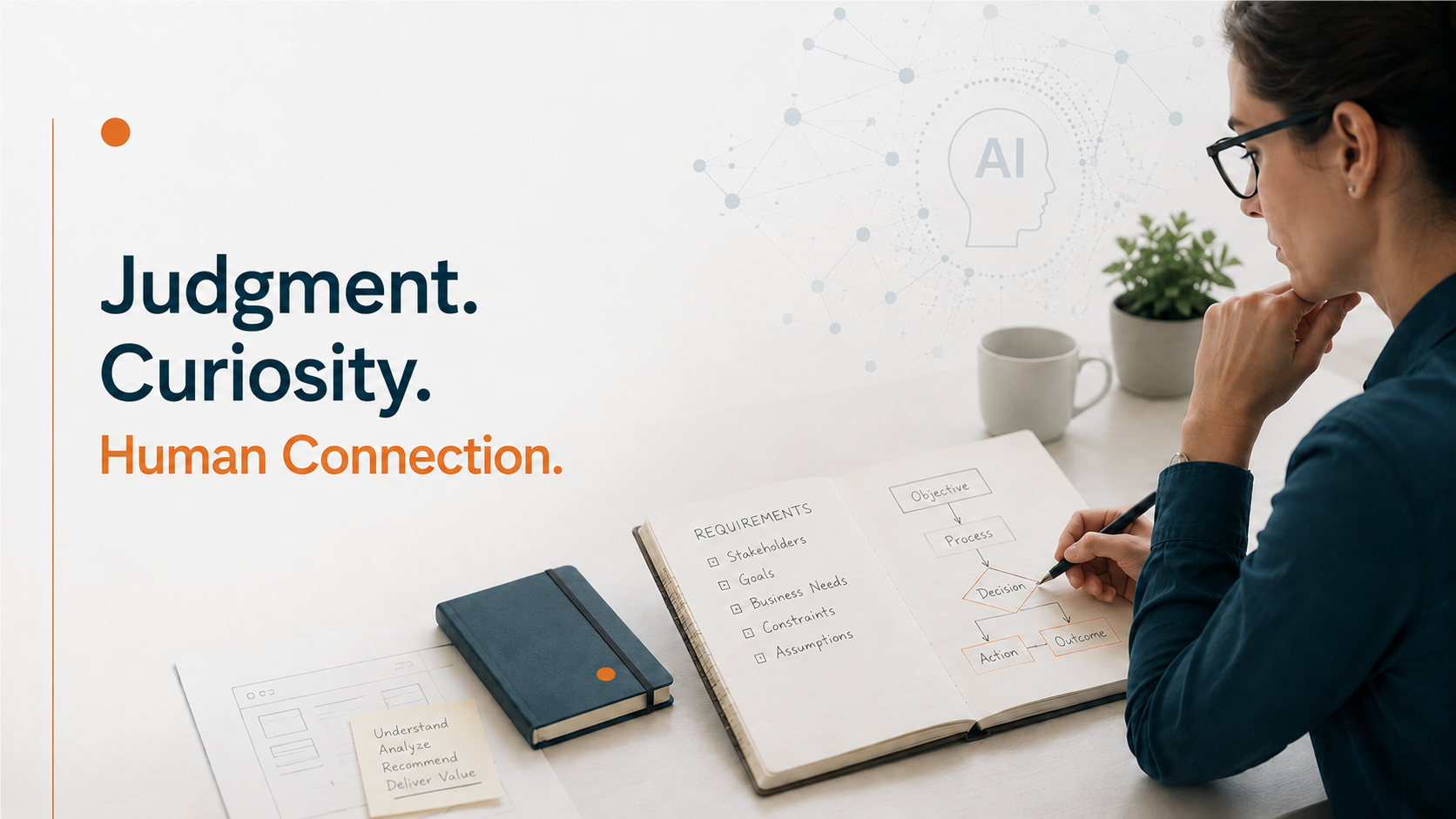
Summary: AI is changing how Business Analysts research, document, and communicate, but it is not replacing the profession. Instead, it is pushing Business Analysts toward more strategic work—where judgment, curiosity, and human connection matter most.
Introduction: A Familiar Profession in Unfamiliar Territory
There Was a time when the work of a Business Analyst was closely associated with requirements documents, process diagrams, and carefully maintained spreadsheets. Those activities still matter, but they no longer define the profession.
Today, Business Analysts are expected to understand customer needs, challenge assumptions, contribute to product decisions, improve processes, support organizational change, and help leaders make sense of increasingly complex choices. We are often asked to step into a situation where the problem is unclear, stakeholders disagree, and everyone wants an answer quickly.
Artificial intelligence has now entered that environment.
It can summarize a meeting in seconds, create a first draft of a requirements document, suggest acceptance criteria, or organize a large amount of stakeholder feedback. Tasks that once took hours can sometimes be completed in minutes.
That naturally raises a difficult question: if AI can perform some of the work traditionally done by Business Analysts, what happens to the profession?
The findings of IIBA’s 2026 Global State of Business Analysis Report suggest that the profession is not disappearing. It is evolving. The report draws on responses from 2,120 professionals across 122 countries, and 69% of respondents say AI is having a positive impact on their careers. Only 5% describe its impact as negative.
Those figures are encouraging, but they do not mean we can continue working in exactly the same way. AI is changing what organizations expect from us—and what we should expect from ourselves.
Business Analysis Has Already Moved Beyond Requirements
The idea that a Business Analyst simply receives requests from stakeholders and turns them into requirements has been outdated for some time.
Good business analysis begins before anyone writes a user story or opens a requirements template. It begins by asking why a change is needed, what outcome the organization wants, who will be affected, and whether the proposed solution addresses the real problem.
The 2026 report found that business analysis is formally recognized in the organizations of 81% of respondents. This figure has remained stable for three years. It shows that business analysis is no longer viewed as a temporary project activity in many organizations. It is becoming an established organizational capability.
However, formal recognition does not always mean that Business Analysts are involved at the right time. Many are still invited into an initiative after important decisions have already been made. The technology has been selected, the budget has been approved, or a senior stakeholder has already decided what the solution should look like.
At that point, the Business Analyst is often expected to document a decision rather than help shape it.
The profession creates much more value when Business Analysts are involved early—while the problem is still being explored and different options remain open. This is where we can question assumptions, connect strategy with delivery, identify overlooked risks, and help stakeholders agree on what success actually means.
AI makes this shift even more important. If technology can produce documentation quickly, our value cannot depend only on producing documents. It must come from the quality of the thinking behind them.
AI Is Taking Over Tasks, Not Accountability
The report gives us a useful picture of how Business Analysts are currently using AI. The most common uses include drafting and formatting, reported by 28% of respondents; communication and documentation, reported by 25%; and idea generation or problem-solving, reported by 22%.
These are practical applications, and they make sense. Few people enter the business analysis profession because they are passionate about reformatting meeting notes or repeatedly rewriting the same information for different audiences.
AI can help with that work.
It can produce an initial draft of a business case, summarize a workshop, suggest discovery questions, turn rough notes into structured requirements, or identify gaps in a document. It can also help us explore alternative scenarios when we are trying to understand a problem.
I use the words “initial draft” deliberately.
AI can create something that looks complete and professional while still being wrong. It does not automatically understand the history of an organization, the relationships between stakeholders, the limitations of existing systems, or the reasons a previous initiative failed. It may not recognize that one stakeholder is reluctant to speak openly or that a seemingly small process change will create additional work for an already overstretched team.
Most importantly, AI is not accountable for the consequences of its recommendations.
The Business Analyst remains responsible for checking the information, understanding the context, involving the right people, and determining whether the output makes sense. We cannot delegate professional judgment to a tool simply because its response is fast and confidently written.
The More We Use AI, the More Human Our Work Becomes
One of the most interesting findings in the 2026 report is that communication remains the most highly valued skill for the third consecutive year. Critical thinking moved into second place, followed by problem-solving, listening, and stakeholder engagement.
These are not technical skills. They are deeply human ones.
At first, this may seem surprising. If organizations are adopting more advanced technology, we might expect technical skills to dominate. In reality, the opposite is happening. As technology becomes better at processing information and producing content, the ability to interpret, question, influence, and build trust becomes more valuable.
A meeting transcript can tell us what people said. It cannot always tell us what they meant.
A generated list of requirements may appear logical. It cannot determine whether the stakeholders genuinely share the same understanding of the problem.
An AI tool can suggest several possible solutions. It cannot take responsibility for choosing the option that best balances customer needs, cost, risk, feasibility, and organizational priorities.
This is why listening matters. It is why facilitation matters. It is why Business Analysts must be comfortable asking difficult questions and respectfully challenging senior stakeholders.
In an AI-enabled workplace, our contribution will be measured less by the volume of documents we produce and more by the clarity we create.
Asking the Right Question Is More Important Than Generating a Fast Answer
AI is exceptionally good at answering questions. The difficulty is that organizations do not always begin with the right question.
A stakeholder may request a chatbot when the real problem is that customers cannot find accurate information. A manager may ask for automation when the underlying process contains unnecessary approvals. A product team may request a new feature when existing functionality is poorly understood or difficult to use.
If we accept the initial request without examining it, AI may simply help us move faster in the wrong direction.
This is where business analysis becomes essential. Before discussing what AI can build, we need to understand what problem should be solved.
We need to ask:
-
What is happening today?
-
Why is it a problem?
-
Who is affected?
-
What evidence do we have?
-
What outcome are we trying to achieve?
-
How will we know whether the change has worked?
-
Is AI genuinely the right solution?
Sometimes AI will be part of the answer. Sometimes a process change, clearer communication, better training, or a simpler system improvement will deliver more value.
A Business Analyst should be able to recognize the difference.
Requirements Are Becoming More Continuous and Evidence-Based
Requirements were once treated as something that could be completed at the beginning of a project and then handed over to a delivery team. That approach is increasingly difficult to sustain.
Customer expectations change quickly. Digital products generate constant feedback. New regulations appear, competitors introduce new services, and organizations learn more as soon as a solution reaches real users.
Business analysis therefore needs to continue throughout the life of a product or change initiative.
AI can support this shift by helping us examine large volumes of customer comments, service requests, survey responses, or operational data. It may reveal patterns that would be difficult to identify manually. It can also help teams update documentation and explore the possible effects of changing a requirement.
But an AI-generated pattern is not automatically a business insight.
We still need to understand where the data came from, whether it represents the right customers, and what may be missing. If the source data reflects an existing bias, the AI output may repeat or even strengthen that bias.
The responsible approach is to treat AI-generated findings as starting points for investigation—not as unquestionable conclusions.
Business Analysts Have an Important Role in Responsible AI
When organizations introduce AI-enabled products and processes, someone needs to ask questions that go beyond technical performance.
What data will the solution use? Do we have permission to use it? Who could be harmed if the output is incorrect? Can a person challenge an automated decision? When should human approval be mandatory? How will we monitor the solution after implementation?
These questions belong naturally within business analysis.
We are trained to examine needs, stakeholders, rules, risks, assumptions, and outcomes. Those capabilities are essential when AI influences customer experiences or business decisions.
Business Analysts can help define where AI should and should not be used. We can document the need for human oversight, clarify decision-making responsibilities, and ensure that requirements cover privacy, security, transparency, fairness, and accessibility.
This is an opportunity for the profession to become even more influential.
Instead of joining an AI initiative only to document system functionality, Business Analysts should help shape the initiative from the beginning. We should be part of the conversation about why AI is being introduced, what value it is expected to deliver, and what safeguards are necessary.
AI Literacy Is Now Part of Being a Business Analyst
Business Analysts do not need to become machine-learning engineers. We do, however, need enough AI literacy to use these tools responsibly and to collaborate confidently with technical teams.
That means understanding what generative AI can and cannot do. It means being aware of inaccurate outputs, bias, privacy concerns, intellectual-property risks, and the dangers of entering confidential organizational information into an unapproved tool.
It also means learning through practice.
Start with low-risk activities. Use AI to improve the wording of a document, generate questions for a workshop, or suggest scenarios you may not have considered. Then review the result critically. Look for incorrect assumptions, vague language, missing stakeholders, and recommendations that do not fit the real context.
The aim is not to use AI in every part of our work. It is to recognize when it adds value and when our established business analysis techniques are more appropriate.
Professional Growth Requires More Than Learning New Tools
The report shows that 70% of respondents work for employers that invest in training and professional development. This is positive because adapting to AI will require more than a one-time course.
Tools will continue to change. A platform that seems essential today may be replaced by something better next year. Professional foundations are more durable.
Business Analysts should continue strengthening their knowledge of strategy analysis, requirements engineering, process improvement, stakeholder engagement, solution evaluation, Agile delivery, product ownership, data analysis, and cybersecurity.
At the same time, we should invest in the capabilities that allow us to apply that knowledge effectively: curiosity, critical thinking, communication, negotiation, and facilitation.
Certification also remains an important part of professional development. In the 2026 report, 94% of certified respondents said they would recommend certification to a colleague, and 76% reported experiencing tangible benefits within the first year.
A certification does not replace experience, but it can provide structure, professional language, and confidence. Combined with practical AI literacy and strong human skills, it can help Business Analysts navigate a profession that is changing quickly.
What Should Business Analysts Do Now?
We do not need to wait for a perfect AI strategy before we begin adapting.
The first step is to become curious. Explore how AI can support your work, but do so within your organization’s privacy, security, and governance rules.
The second step is to stay critical. Never assume that a professional-looking answer is an accurate one. Verify facts, review assumptions, and involve the people who understand the business context.
The third step is to reinvest the time you save. If AI reduces the time needed to prepare a document, use that time to speak with another stakeholder, investigate the root cause, test an assumption, or think more deeply about the expected outcome.
AI should not make our analysis shallower. It should give us room to make it better.
Conclusion: Our Value Is Not in the Template
The Business Analyst of the future may produce fewer documents manually. That does not mean the profession will become less important.
Our real value has never been in the template, the diagram, or the meeting notes. Those are tools we use to create understanding. Our value lies in bringing people together, making complexity manageable, asking questions others may overlook, and helping organizations make decisions that lead to meaningful change.
AI can help us work faster. It can broaden our thinking and reduce repetitive effort. But it cannot replace our responsibility to understand the problem, consider the people affected, and guide the organization toward the right outcome.
The future does not belong to Business Analysts who ignore AI. Nor does it belong to those who accept every AI-generated answer without question.
It belongs to professionals who know how to use technology while continuing to think independently, listen carefully, and keep human needs at the centre of change.
That is not the end of business analysis. It is the profession’s next chapter.
🌐Report data referenced in this article comes from IIBA’s 2026 Global State of Business Analysis Report overview and Global State of Business Analysis research page.

Tinatin Papashvili is the Founding President of IIBA Georgia Chapter, a position she has held since September 2025. She is also an experienced Business Analysis Team Lead, Project Manager, and Product Owner with more than 10 years of experience connecting business needs with technology delivery. Recognized as the first Georgian Certified Agile Analysis Professional (AAC®). Tinatin is passionate about mentoring teams, strengthening professional communities, and delivering value-driven digital products.